Introduction
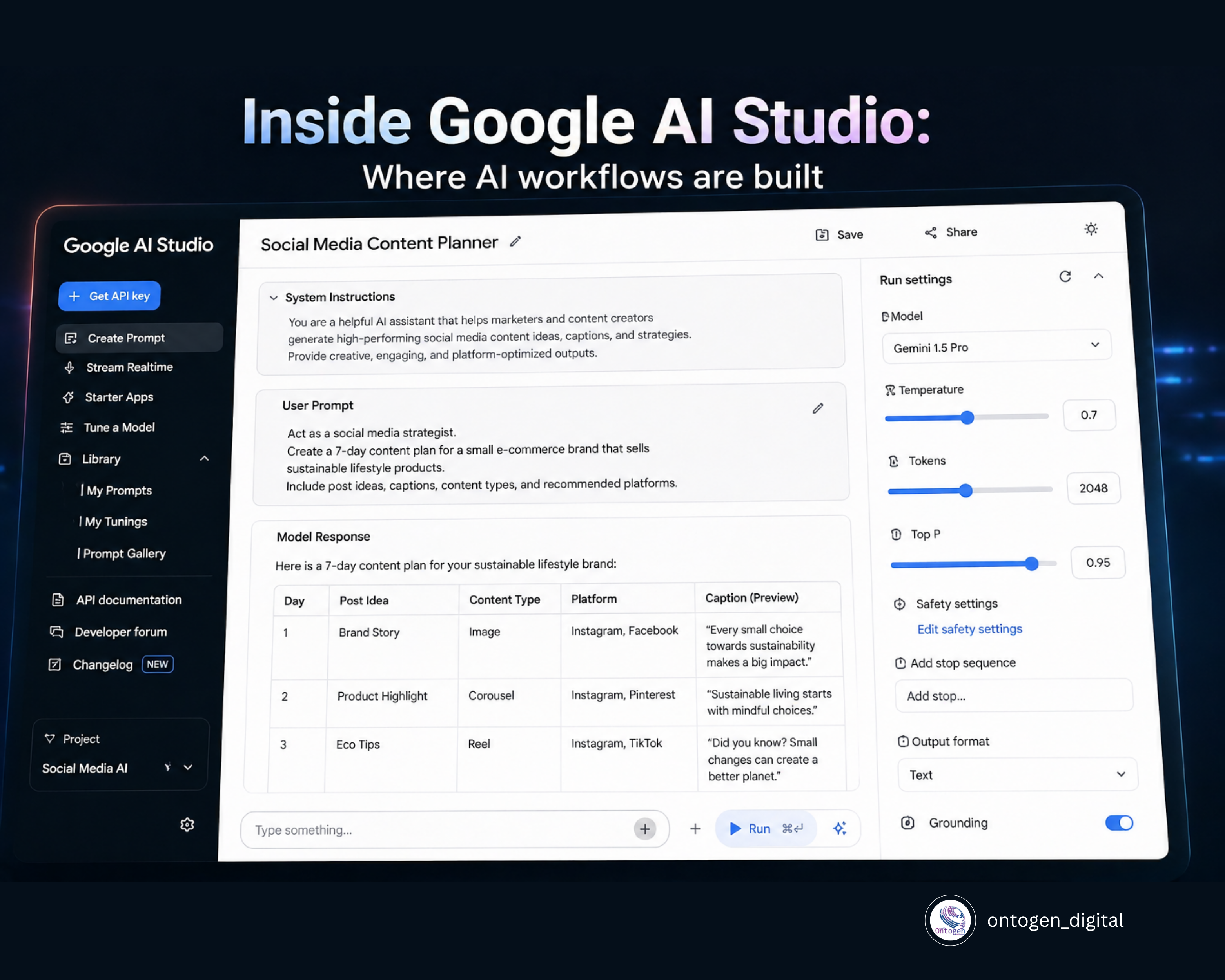
AI is no longer a future trend; it's the present engine behind how businesses grow, market, and operate. From automating customer support to generating high-converting ad copy, AI tools are reshaping how small and mid-sized businesses compete with larger players.
One of the most powerful tools emerging from this shift is Google AI Studio, a platform designed to make advanced AI capabilities accessible without requiring deep technical expertise.
But here's the real question:
Is it just another AI tool, or can it actually give your business a competitive advantage?
In this guide, we'll break down everything you need to know about Google AI Studio: what it is, how it works, and most importantly, how you can use it to grow your business in a practical, results-driven way.
What is Google AI Studio?
At its core, Google AI Studio is a powerful platform designed to help businesses, developers, and marketers move beyond simply using AI and start building with it. It allows you to experiment with and create AI-powered applications using advanced models like Gemini, but in a way that feels practical and accessible even if you don't come from a technical background.
Think of it as a combination of a playground and a toolkit. On one side, it gives you the freedom to test ideas, explore how AI responds to different instructions, and understand its capabilities in real time. On the other, it provides structured tools that let you turn those experiments into usable systems that can support your business operations.
With Google AI Studio, you can:
Create and refine AI prompts that match your brand voice and business goals
Test content generation for blogs, ads, emails, and landing pages
Build simple to advanced automation systems for repetitive tasks
What makes this platform stand out is the level of control it offers. Unlike traditional AI tools that generate one-size-fits-all outputs, Google AI Studio allows you to guide how the AI behaves whether it's adjusting tone, structuring responses, or aligning outputs with a specific audience. This flexibility makes it far more useful for real business applications, where consistency and personalization matter.
This shift is more important than it seems. Businesses are no longer limited to using AI as a shortcut for isolated tasks. Instead, they are beginning to design AI-driven systems that handle workflows, improve efficiency, and scale operations. In simple terms, the transition is happening from using AI tools to building AI ecosystems tailored to specific business needs, and Google AI Studio sits right at the center of that transformation.
Why Google AI Studio Matters for Businesses in 2026
AI adoption is accelerating at a pace most businesses didn't anticipate even a few years ago. Recent industry insights suggest that a large percentage of small and mid-sized businesses in the US are already experimenting with AI in some capacity. However, the reality is that many are still operating at a surface level using AI mainly for basic content generation or simple chatbot interactions without tapping into its full potential.
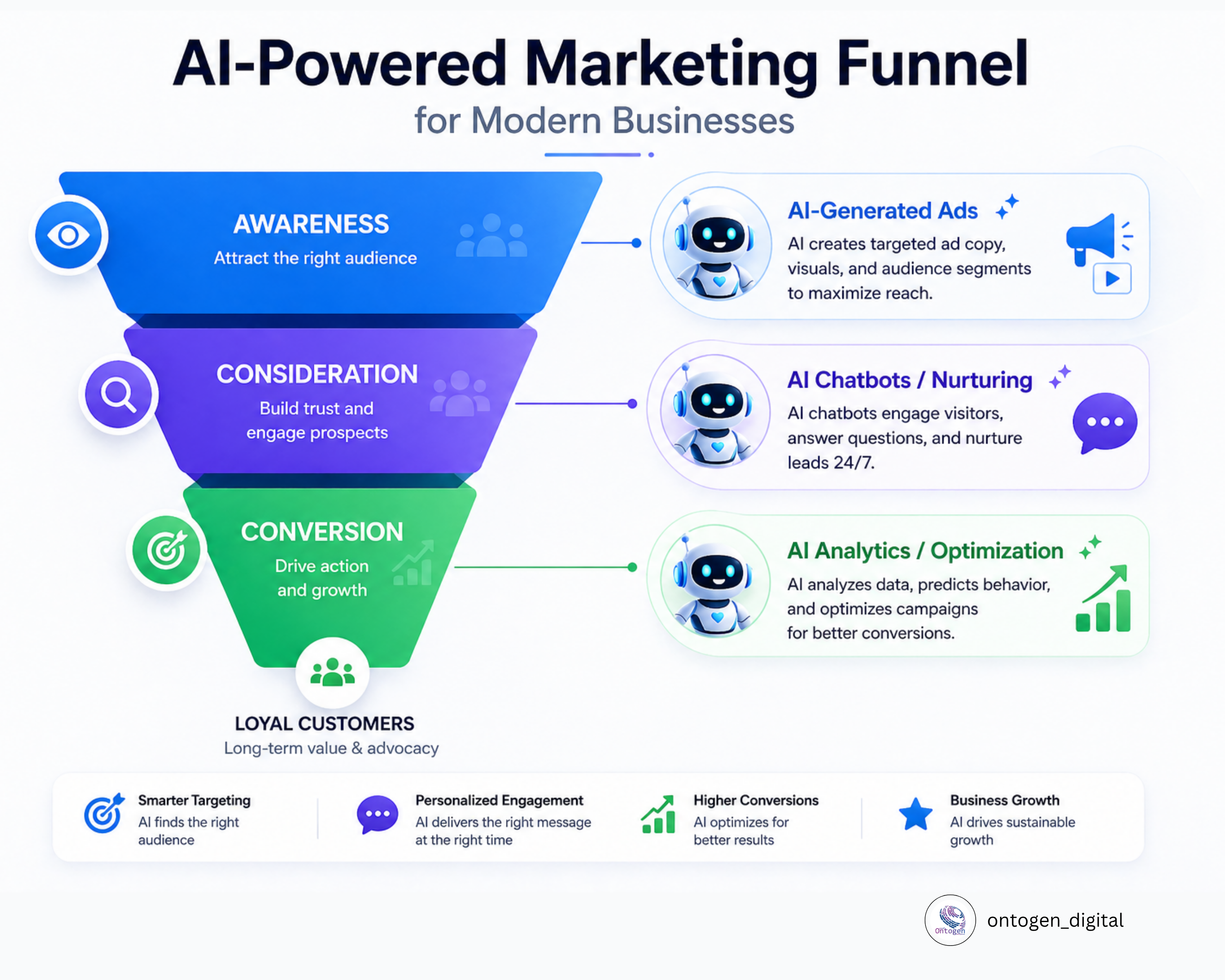
This is where Google AI Studio starts to make a real difference. It shifts AI from being a tool you occasionally use to something you actively build into your business processes. Instead of relying on generic outputs, businesses can design structured systems that align closely with how they operate and grow.
One of the biggest advantages is the ability to create custom AI workflows. Rather than generating one-off responses, you can build flows that handle specific tasks end-to-end. For example, an AI system can qualify incoming leads by asking the right questions, respond to customer queries instantly with context-aware answers, and even trigger personalized marketing sequences based on user behavior. This kind of structured automation brings consistency and scalability that manual processes simply cannot match.
Another major impact is cost efficiency. Businesses often spend heavily on repetitive tasks that don't necessarily require human creativity or strategic thinking. With AI, many of these functions such as customer support, content drafting, and even initial data analysis can be handled automatically. This doesn't just reduce costs; it allows teams to focus on higher-value work like strategy, creativity, and growth planning.
Speed is another area where the difference becomes very noticeable. Campaigns that once required weeks of planning, execution, and iteration can now be launched much faster. With AI assisting in content creation, audience analysis, and optimization, businesses can move from idea to execution in a matter of hours or days, giving them a strong competitive edge in fast-moving markets.
Finally, AI enables smarter, data-driven decision-making. Instead of relying on assumptions or delayed reports, businesses can analyze large volumes of data almost instantly. This means understanding what's working, identifying gaps, and adjusting strategies in real time. When used effectively, this level of insight can significantly improve both marketing performance and overall business operations.
The key takeaway here is simple: AI is no longer just about saving time; it's about building smarter, faster, and more efficient systems that can scale with your business.
How Google AI Studio Works (Simplified)
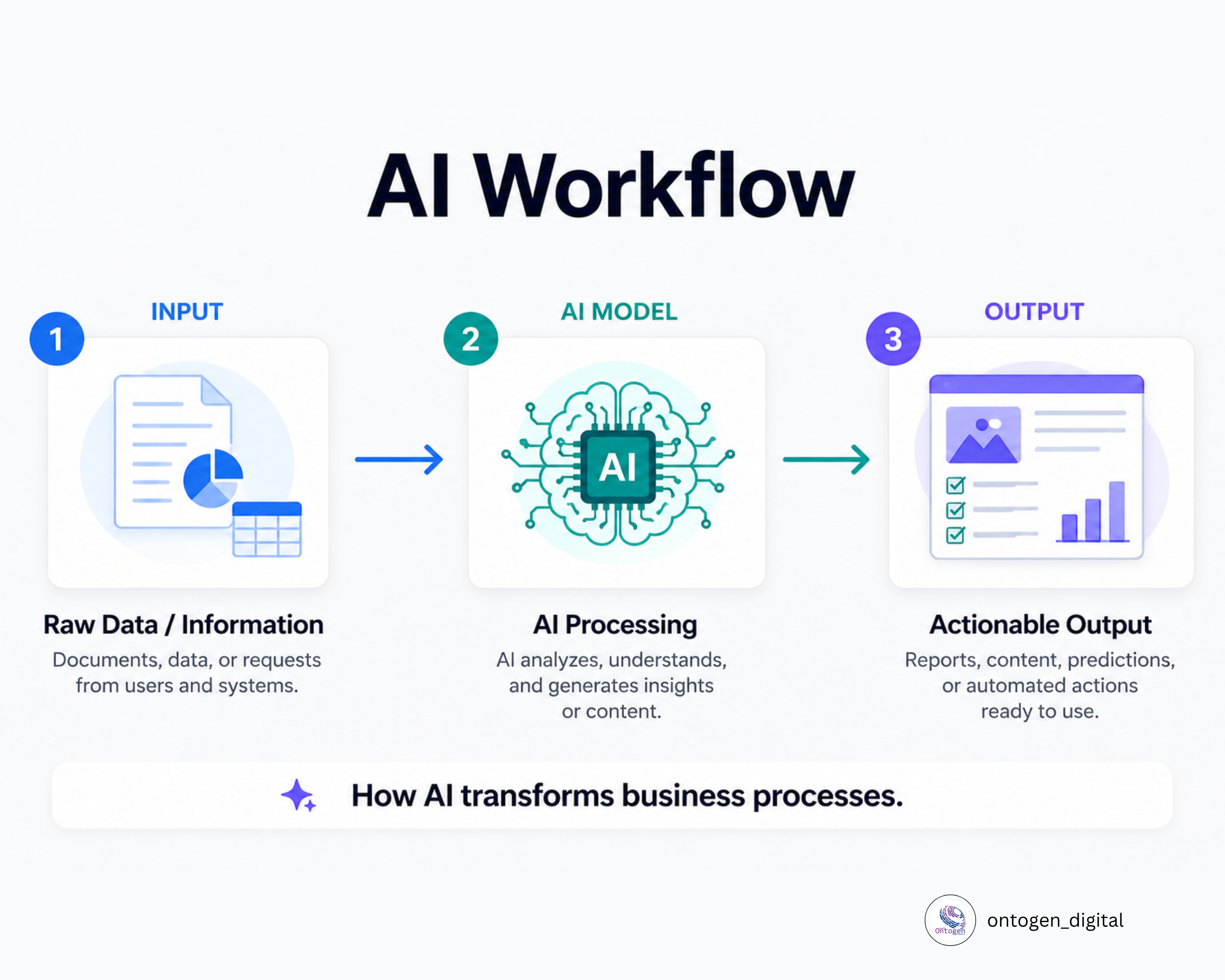
Understanding how it works doesn't require a technical background.
Here's a simple breakdown:
Input → Model → Output
Input: You give instructions (prompt)
Model: AI processes using advanced algorithms
Output: You get results (text, insights, automation)
But the real power lies in the following:
Prompt Engineering
You can design prompts that:
Control tone (professional, casual, persuasive)
Define audience (US SMBs, Indian startups, etc.)
Set structure (blog, ad copy, email funnel)
This means the AI becomes aligned with your business goals, not generic outputs.
Read Also: AI in Marketing (2024): Personalized Experiences
Practical Ways to Use Google AI Studio for Your Business
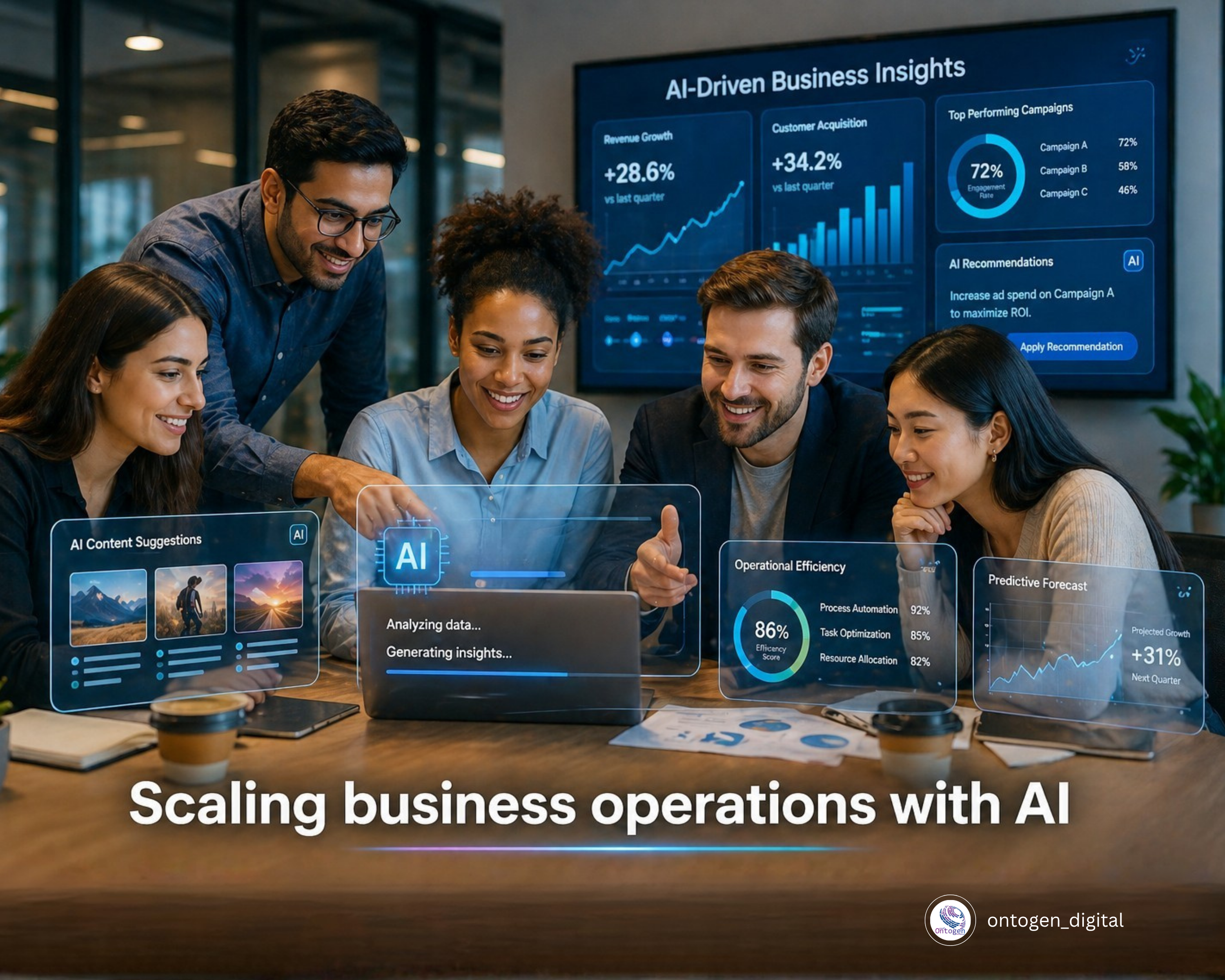
Let's move beyond theory.
Here's how businesses are actually using it:
1. AI-Powered Content Marketing
Content is still king, but creating consistent, high-quality content is challenging.
With Google AI Studio, you can:
Generate blog drafts • Create SEO outlines • Write ad copy • Produce email campaigns
Example (US SMB): A home improvement company in Texas used AI workflows to generate 20 blog posts per month, optimize for local SEO, and increase organic traffic by 65% in just 4 months.
Key Insight: AI doesn't replace strategy; it scales execution.
2. Lead Generation & Qualification
Instead of manually filtering leads, AI can:
Ask qualifying questions • Score leads based on responses • Route high-quality leads to sales teams
Example (India): A real estate firm in Mumbai implemented an AI chatbot using similar systems, reducing unqualified inquiries by 40% and increasing conversion rates by 25%.
3. Customer Support Automation
AI can handle customer inquiries with speed and precision:
FAQs • Order tracking • Appointment booking • Returns and exchanges • Account management
This transformation delivers measurable improvements:
Faster response times • Higher customer satisfaction • Reduced operational costs • 24/7 availability
4. Ad Campaign Optimization
AI analyzes performance data and suggests intelligent improvements:
Better audience targeting • Improved ad copy variations • Smarter budget allocation • Real-time bid adjustments
This is especially powerful when combined with platforms like Google Ads.
5. Data Analysis & Insights
AI turns raw data into actionable business intelligence:
Which campaigns are driving results • Where customers drop off in the funnel • What messaging truly resonates • How to predict future trends
Strategic Framework: How to Implement Google AI Studio
Most businesses don't fail with AI because the technology doesn't work; they fail because they approach it without a clear plan. They either try to automate everything at once or expect instant results without understanding how AI fits into their existing processes. To get real business value, you need a structured approach. That's where a platform like Google AI Studio becomes powerful, not just as a tool, but as a system-building environment.
Here's a practical framework to help you implement it effectively:
Step 1: Identify Repetitive Tasks
The first step is not about AI; it's about your business operations. You need to clearly identify where time is being spent on repetitive, rule-based tasks that don't require deep human creativity or decision-making. These are the areas where AI delivers the fastest and most noticeable impact , where you can use AI to automate the repetitive tasks.
Look closely at your daily workflows, and you'll often find patterns like:
Content creation tasks – blogs, ad copies, email campaigns that follow predictable structures
Customer queries and support interactions – FAQs and routine questions that drain team energy
Lead filtering and qualification – hours spent identifying which leads are actually serious
The goal here is not to replace your team but to remove operational bottlenecks so your team can focus on higher-value work like strategy, sales, and relationship building.
Step 2: Define Clear Outcomes
One of the biggest mistakes businesses make is using vague goals like "we want to use AI." That approach rarely leads to measurable results. Instead, you need to define specific, outcome-driven objectives that align with your business growth.
For example:
Instead of "we want more leads" → increase qualified leads by 20% within 3 months using AI-driven filtering
Rather than "improve customer service" → reduce average response time to under 2 minutes through automated AI responses
If content is your focus → generate 10 high-quality blog posts per month while maintaining SEO standards
When your goals are this specific, AI becomes a tool that works toward clear outcomes — not just an experiment.
Read Also: Programmatic Ads: How They Benefit Performance Marketing
Step 3: Build Simple Workflows First
A common trap businesses fall into is trying to build complex AI systems right from the start. This often leads to confusion, poor implementation, and wasted resources. The smarter approach is to start small and build confidence with simple, high-impact workflows.
You can begin with foundational use cases:
Content generation workflows – AI creates structured drafts for blogs, ad copies, or social posts, then your team refines for quality and brand voice
Chatbot or response systems – AI handles initial customer interactions, answers common questions, and directs users to the right solutions
Once these basic systems are running smoothly, gradually expand into multi-step automation, personalized marketing sequences, or AI-driven analytics.
Step 4: Optimize & Iterate
AI is not a "set it and forget it" solution. Its real strength lies in continuous improvement. The more you refine your inputs and analyze outputs, the better your system becomes.
Track performance across key areas:
Output quality – Does AI-generated content meet your brand standards?
Conversion impact – Are leads, sales, and engagement improving?
Engagement metrics – Click-through rates, response rates, time spent on content
As you gather data, continuously tweak your prompts, workflows, and strategies. Over time, this creates a system that is not only efficient but also highly optimized for your specific business goals.
Case Studies: Real Business Applications
Case Study 1: US-Based E-commerce Brand
A Shopify store selling fitness products used AI to generate product descriptions, automate email marketing, and deliver personalized recommendations.
Results: 35% increase in email conversions • 20% reduction in content production costs
Case Study 2: Indian Digital Agency
A Pune-based agency (similar to Ontogen Digital) used AI workflows for client reporting, automated SEO audits, and generated content drafts.
Results: Saved 15+ hours per week • Improved client delivery speed • Scaled operations without hiring
Common Mistakes Businesses Make
1. Treating AI as a Shortcut
AI is not magic. Without strategy, results will be average.
2. Poor Prompting
Generic prompts = generic outputs. Garbage in, garbage out.
3. Over-Automation
Not everything should be automated. Human touch, empathy, and creativity still matter.
4. Ignoring Data Privacy
Businesses must ensure compliance when handling customer data. Trust is non-negotiable.
Future of AI Studio & Business Growth (2026 and Beyond)
The future of AI isn't just about using tools occasionally; it's about building AI-driven systems that operate as a core part of your business. Companies that understand this shift early are the ones that will scale faster, operate more efficiently, and stay ahead of the competition. Platforms like Google AI Studio are accelerating this transition by making it easier to design and connect these systems.
There are a few key trends shaping this shift:
AI + Personalization: Marketing is moving toward hyper-personalization, where every user sees content, offers, and messaging tailored specifically to their behavior and preferences. AI makes it possible to deliver this at scale without increasing workload.
AI Agents: We're entering a phase where AI doesn't just assist; it acts. AI agents can handle tasks end-to-end, such as managing customer conversations, qualifying leads, or even optimizing campaigns automatically.
Voice & Multimodal AI: The interaction with AI is expanding beyond text. Businesses will increasingly use a combination of voice, images, and text to create more natural and engaging user experiences.
Integration Across Platforms: AI will no longer work in isolation. It will connect seamlessly with CRM systems, ad platforms, websites, and analytics tools, creating a unified system where data flows and decisions happen in real time.
The businesses that adapt to these trends early won't just improve efficiency; they'll build a strong competitive advantage that becomes harder for others to catch up with.
How Ontogen Digital Helps You Leverage AI
At Ontogen Digital, the focus isn't just on adopting new tools; it's about using them in a way that actually drives measurable business outcomes. AI on its own doesn't guarantee results. What matters is how it's integrated into your marketing strategy, how it's guided, and how consistently it's optimized.
Instead of treating AI as a shortcut, the approach is to combine AI capabilities with human strategy and pros and cons of AI, ensuring that every output aligns with your brand, audience, and growth goals.
Here's how that translates across different areas of digital marketing:
SEO (Search Engine Optimization)
AI is used to enhance research, identify content gaps, and analyze search intent more efficiently. But rankings don't come from AI alone they come from strategy, consistency, and understanding what users are actually looking for.
At Ontogen Digital, AI helps speed up keyword research, competitor analysis, and content structuring, while the strategy layer ensures that content is relevant, valuable, and aligned with long-term organic growth. The result is not just more content, but content that performs.
(Explore our SEO services.)
PPC / Paid Advertising
Paid campaigns generate data constantly, but most businesses struggle to use that data effectively. This is where AI becomes valuable.
By leveraging AI-driven insights, campaigns can be monitored and adjusted faster—whether it's refining audience targeting, improving ad copy, or reallocating budgets based on performance. However, the decision-making is still guided by experience and business goals, ensuring that automation doesn't lead to wasted spend.
This balance helps improve ROI without overcomplicating the process.
(Learn more about PPC advertising.)
Content Marketing
AI has made content creation faster, but speed alone doesn't drive engagement or conversions. The real impact comes when AI-generated content is guided by a clear narrative, audience understanding, and brand voice.
At Ontogen Digital, AI is used to support content production whether it's generating drafts, structuring ideas, or scaling output. Then, human input refines that content to ensure it connects with the audience and serves a clear purpose within the marketing funnel.
This approach maintains quality while increasing consistency.
Web Development
Modern websites are no longer just digital brochures; they're performance-driven assets. AI plays a role in improving user experience, analyzing behavior, and identifying areas where visitors drop off.
By integrating AI insights into the development process, websites can be optimized for speed, usability, and conversions. This includes smarter layouts, better content placement, and data-backed improvements that enhance overall performance.
The goal is simple: create websites that don't just look good but actually convert.
CGI / Creative
Visual content is becoming more important than ever, especially in a crowded digital space. AI can assist in generating ideas and speeding up production, but creativity still requires a human touch.
The focus here is on combining AI-assisted workflows with strong creative direction to produce visuals that stand out and communicate clearly. Whether it's ad creatives or branded visuals, the aim is to maintain originality while improving efficiency.
Personalized Marketing Strategy
Every business operates differently, which means there's no one-size-fits-all approach to AI or marketing. Instead of applying generic solutions, strategies are built around your specific goals, audience, and market position.
AI helps in analyzing data, identifying patterns, and predicting outcomes, but the final strategy is shaped by understanding your business deeply. This ensures that every campaign, piece of content, and system is aligned with what actually drives growth for you.
FAQs (People Also Ask Optimized)
What is Google AI Studio used for?
It's used to build, test, and deploy AI-powered workflows for content, automation, and business operations.
Is Google AI Studio free?
It offers free access with limitations, but advanced usage may involve costs based on API usage.
Can small businesses use Google AI Studio?
Yes, it's designed to be accessible even without deep technical expertise.
How is it different from ChatGPT?
It provides more control and customization, especially for building structured workflows.
Do I need coding skills?
Basic usage doesn't require coding, but advanced integrations may.
Is it safe for business data?
Yes, but businesses should follow data privacy and compliance guidelines.
Conclusion
Google AI Studio is not just another tool; it's a shift in how businesses operate, market, and grow.
The businesses that win in 2026 won't be the ones using AI occasionally. They'll be the ones building AI-powered systems that run consistently and efficiently.
If you're serious about scaling your business, improving efficiency, and staying ahead of competitors, this is something you cannot ignore.
Ready to Build an AI-Driven Growth System?
Partner with Ontogen Digital to:
Implement AI into your marketing • Scale your lead generation • Build a performance-driven strategy
👉 Get in touch today and start building your future-ready business.