The Real Reason Most E-Commerce Businesses Don't Scale
There is a persistent myth in the e-commerce world: "If I can just get more traffic, the sales will follow."
On the surface, it makes sense. More eyeballs should equal more buyers. But if growth were that linear, every brand with a functioning ad account would be profitable. In reality, thousands of stores launch every month with great products and beautiful websites, only to hit a wall within ninety days.
The reason isn't a lack of effort; it's a lack of architecture.
From Random Acts to Predictable Systems
Most founders are running "random acts of marketing." They run ads because they feel they should, post on social media because everyone else is, and slash prices the moment sales dip. This is reactive, not strategic. When you run ads without a specific narrative, or offer discounts without building value first, you aren't building a brand — you're just chasing a transaction.
We have to acknowledge that the modern consumer has changed. Today's buyer is more skeptical, more distracted, and has more options than ever before. You aren't just competing with other stores; you're competing with every notification on their phone. Simply "existing" online is no longer enough to win.
What This Guide Is (And Isn't)
This isn't a list of "quick tips" or trendy hacks that will be obsolete by next month. Instead, we are going to break down a proven e-commerce growth engine — the same fundamental system used by seven and eight-figure brands to scale predictably.
Whether you are trying to get your first consistent month of sales or you're stuck at a plateau you can't seem to break through, this strategy is designed to give you total clarity.
By the time you finish reading, you'll know how to:
Identify and attract high-intent buyers (Acquisition)
Turn skeptical visitors into confident customers (Conversion)
Maximize the value of every person who buys from you (Retention)
Let's stop pouring water into a leaky bucket and start building a foundation that actually holds.
1. The E-Commerce Growth Engine: Beyond the Traffic Obsession
Most founders treat their business like a volume game. They operate on a simple, flawed linear equation: More Ads → More Visitors → More Sales.
The problem with this logic is that it treats traffic as a cure-all. If your foundation is weak, adding more traffic is like trying to fill a bucket with a hole in the bottom. You aren't growing; you're just wasting money at a faster rate. A sustainable brand is built on three high-leverage pillars that must work in a closed loop.
Pillar 1: Strategic Acquisition
Acquisition is about more than "getting clicks." It's about intent. If your messaging is vague, you attract "window shoppers" who will never buy. If your targeting is off, you're paying for the wrong audience. High traffic with low sales isn't a traffic problem — it's a qualification problem.
Pillar 2: Conversion (The Multiplier)
This is where the real math happens. Your product pages, site speed, and "Add to Cart" flow are your sales team. Consider this: if you have a 1% conversion rate and you double your traffic, your revenue doubles. But if you move your conversion rate from 1% to 3%, you triple your revenue without spending a single extra rupee on ads. Optimization is the highest-ROI activity in your business.
Pillar 3: Retention (The Profit Engine)
Acquiring a new customer is the most expensive thing you will do. If they only buy once, your margins are razor-thin. True scale happens when you turn one customer into five purchases. Retention is where you stop chasing one-off transactions and start building a predictable revenue stream.
The Insight: Growth isn't about doing "more" activities. It's about tightening the screws on these three pillars so that every visitor becomes more valuable and every sale compounds into the next.
2. Customer Psychology: Understanding the "Why" Behind Purchase
If you don't understand the "why" behind a purchase, your marketing will always feel like a shot in the dark. At its core, e-commerce isn't about selling inventory; it's about understanding human behavior.
No one wakes up with a burning desire to own more "stuff." They wake up with frustrations they want to end or aspirations they want to achieve. Your product is simply the vehicle that takes them from their current reality to their desired future.
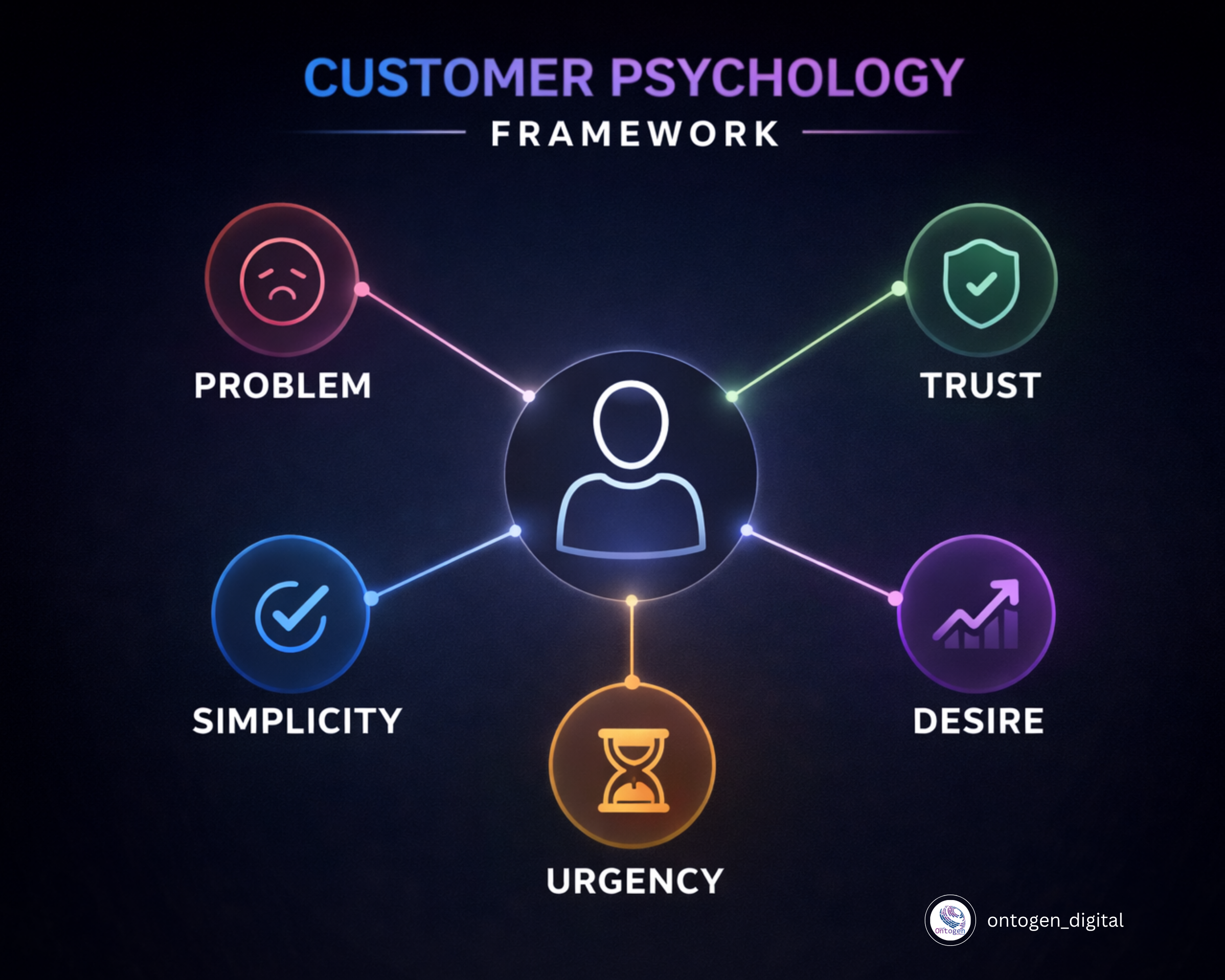
The Two Pillars of Buying Intent
1. Amplifying Problem Awareness
People rarely act on a mild inconvenience; they act when a problem becomes painful enough to demand a solution.
The Surface Level: "I need new skincare." (Low urgency)
The Deep Level: "My skin is making me feel invisible and killing my confidence at work." (High urgency)
Effective marketing doesn't just mention the problem — it amplifies it. It shows the customer that you understand exactly how that problem feels, which instantly builds the trust needed for them to listen to your solution.
2. Selling the Transformation (The "After" State)
One of the biggest mistakes in e-commerce is selling the tool instead of the result.
The Tool: High-quality protein powder with 25g of whey.
The Result: The confidence to walk onto a beach, the energy to play with your kids, or the social validation of a transformed physique.
Customers don't buy a gym membership; they buy the version of themselves that is fit and healthy. Your job is to paint a vivid picture of that "after" state. The clearer you can make that transformation feel, the less friction there is during the sale.
The Real-World Insight: Winning brands don't have the "best" products in a technical sense. They are simply the best at communicating how their product solves a specific pain point and leads to a specific, desirable outcome.
3. The Power of Social Validation
Modern consumers have developed a natural "marketing filter." They are inherently skeptical of what a brand says about itself, but they are incredibly receptive to what others say about that brand. This is why user-generated content (UGC) has become the gold standard of high-converting marketing. Whether it is a raw video review, a detailed before-and-after transformation, or a simple star rating, these elements provide "borrowed trust." When a prospect sees a real person experiencing the transformation they desire, the perceived risk of the purchase drops significantly.
4. Strategic Urgency: Overcoming Procrastination
Human beings are wired to delay decisions. Without a reason to act now, most customers will tell themselves they'll come back later — and they rarely do. This is where "Fear of Missing Out" (FOMO) becomes a functional tool rather than just a tactic. By introducing elements like real-time stock scarcity, genuine limited-time offers, or countdown timers, you create a psychological "nudge" that forces a decision. When used ethically, urgency isn't about tricking the customer; it's about providing the necessary friction to overcome their natural tendency to procrastinate.
5. The Law of Simplicity
The most overlooked killer of e-commerce sales is mental fatigue. If your messaging is cluttered, your navigation is complex, or your value proposition requires a paragraph to explain, you have already lost. A confused mind always says "no." The most successful brands are rarely the ones with the most features; they are the ones that provide the most clarity. By reducing the number of choices and making the path to purchase as linear as possible, you remove the "cognitive load" that prevents people from taking action.
Read also : How to Create a Pay per Click (PPC) Advertising
6. The High-Performance Traffic System: Quality Over Quantity
In the world of e-commerce, not all traffic is created equal. A thousand casual browsers are worth less than ten high-intent buyers. To scale, you must stop chasing "reach" and start attracting the right people at the right time.
A truly resilient brand doesn't rely on a single source of visitors; it builds an ecosystem where three distinct engines work together.

Paid Media: The Growth Accelerator
Paid advertising is the fastest way to scale, but it's also the easiest way to lose money if you lack a strategy. Most founders fail because they focus on "the tech" (buttons and settings) rather than the messaging. Message delivery through your ads is as important as you spending on ads.
The Shift: Stop "running ads" and start "testing hooks."
The Goal: A winning ad isn't just a pretty image. It's a bridge that connects a specific customer problem to your solution. If your ad doesn't stop the scroll within two seconds, it doesn't matter how good your product is.
Organic Content: The Trust Builder
If ads are for speed, organic content is for authority. This is where you humanize your brand. People don't follow companies; they follow stories.
The Strategy: Use "Behind-the-Scenes" content to show transparency, and user-generated content (UGC) to provide social proof. When a real customer shares their transformation journey, it carries ten times the weight of a professional studio shoot.
SEO: The Compound Interest of Marketing
Search Engine Optimization is the most underrated asset in e-commerce. While ads stop working the second you stop paying, SEO continues to deliver high-intent traffic for years.
The Insight: When someone searches for "best waterproof hiking boots," they aren't just browsing — they have active intent to buy. Capturing that person at the exact moment they are looking for a solution is the ultimate "cheat code" for conversion.
The Omnichannel Insight
The most successful brands don't pick one; they integrate all three. They use Paid Ads for immediate reach, Organic Content to nurture that audience, and SEO to capture those who are actively searching for a solution. When these three work in tandem, your cost per acquisition drops, and your brand authority rises.
Read Also: A Guide to Omnichannel Marketing for Indian Brands
7. Conversion Optimization: Building a Sales Machine, Not Just a Store
If getting traffic is an expense, converting that traffic is where you actually "find" your profit. Your website is not just a digital catalog; it is a silent salesperson working 24/7. If that salesperson is confusing, slow, or vague, you are losing money every second.
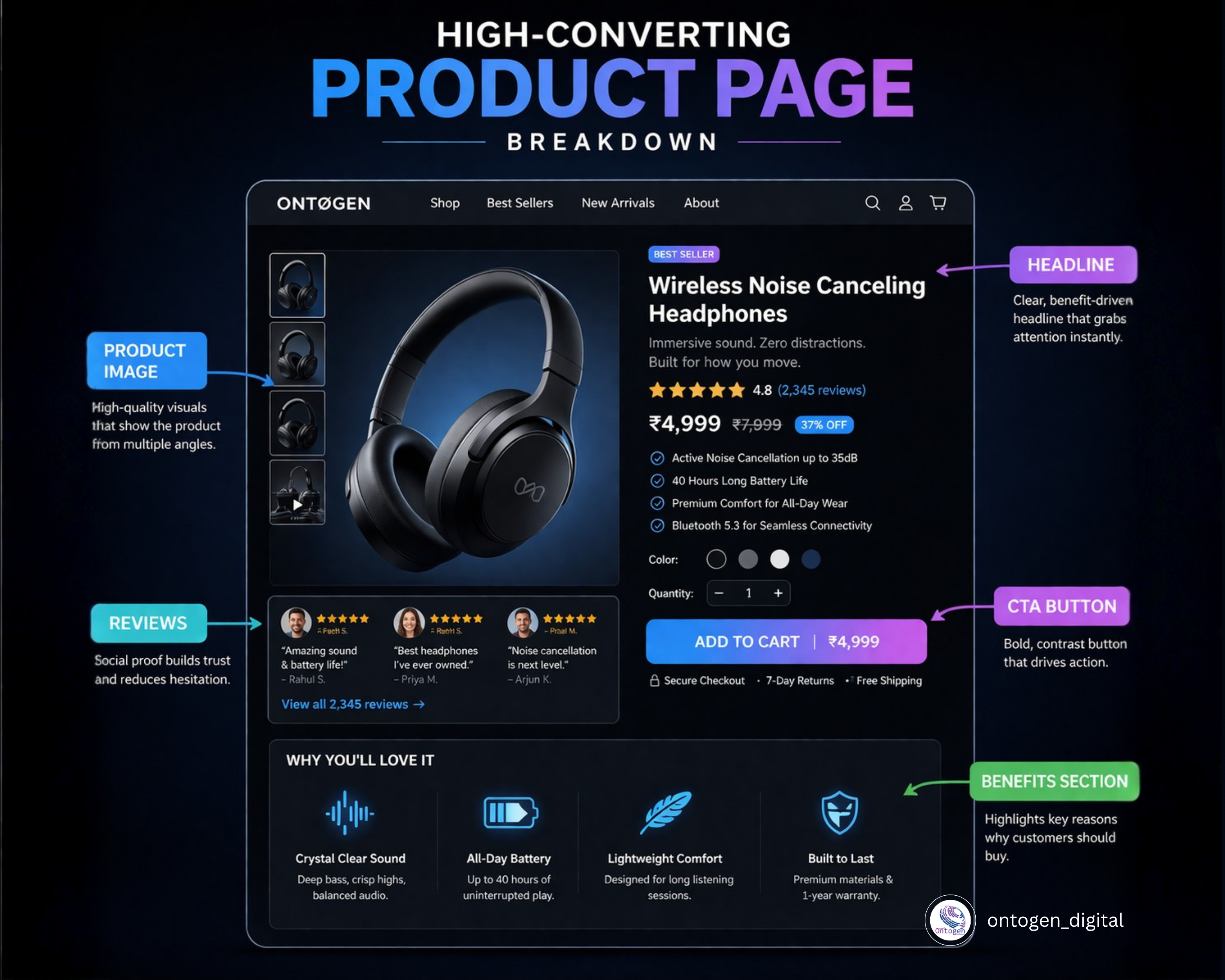
The Anatomy of a High-Converting Page
To turn a stranger into a customer, your site must solve for three things: Clarity, Trust, and Friction.
The 3-Second Rule (Clarity): Within three seconds of landing, a visitor should know exactly what you sell, who it's for, and why they should care. If they have to "figure it out," they will bounce.
Visual Proof over Stock Photos: Don't just show the product; show the result. Use videos of real people using it and high-quality images that highlight the transformation.
Selling Outcomes, Not Specs: A "10,000 mAh battery" is a feature. "Three full days of power on a single charge" is a benefit. Speak to the life the customer wants to live, not just the item they are buying.
Eliminating The "Exit" Points: Every extra click, long form, or mandatory account creation is an opportunity for a customer to leave. A frictionless checkout with local payment options and guest checkout is the fastest way to increase revenue without increasing ad spend.
8. Retention: The Secret Language of Profitable Brands
Most founders are addicted to the "New Customer" high. But smart founders know that the first sale is often the most expensive. True wealth in e-commerce is built on the Second, Third, and Fourth purchase. Why Retention is Your Real Profit Driver Acquiring a new customer can cost 5–10 times more than keeping an existing one. When a customer returns, your Marketing Cost (CAC) is effectively zero for that transaction. This is where your net margins finally begin to expand.
Strategies That Build Loyalty
Automated Lifecycle Marketing: You shouldn't have to manually "sell" to every past buyer. Use email and SMS flows for welcome sequences, abandoned cart recovery, and "win-back" campaigns for people who haven't ordered in 60 days.
The Power of WhatsApp (Direct Access): Especially in markets like India, WhatsApp has become the ultimate tool for high-engagement retention. It's personal, direct, and has open rates that traditional email can't touch.
The Post-Purchase Experience: The "unboxing" isn't the end; it's the start of the next sale. Exceptional packaging, a personalized thank-you note, or a surprise discount for their next order builds the kind of brand affinity that no ad can buy.
The Truth: A business with an average acquisition strategy but a world-class retention system will always outlast a business that only knows how to run ads.
9. The Art of the Irresistible Offer: More Than Just a Price Tag
A common mistake in e-commerce is equating an "offer" with a "discount." If your only lever is lowering the price, you are participating in a race to the bottom that erodes your margins and devalues your brand. A truly sophisticated offer isn't about being the cheapest; it is about creating a perceived value so high that the price becomes secondary to the customer's desire.
An irresistible offer is built on positioning and framing. For example, instead of a simple 20% discount, a "Buy 2, Get 1 Free" bundle often performs better because it increases the average order value while making the customer feel they've gained a significant asset. It's about psychological anchoring when you show a customer that a premium solution was originally ₹1,999 but is available for ₹999 for a limited window, you aren't just selling a product; you are selling a "win." By combining urgency, scarcity, and stacked value, you move the customer from a state of "I'll think about it" to "I can't afford to miss this."
10. The Full-Funnel Architecture: Connecting the Dots
The final step in scaling any e-commerce brand is realizing that your business is not a series of isolated campaigns; it is a connected ecosystem. Success happens when your top-of-funnel awareness feeds perfectly into your bottom-of-funnel conversions.

Top of Funnel (Awareness): This is the "handshake." Here, you aren't asking for a sale; you are introducing a solution to a problem. Your goal is to stop the scroll and earn enough trust for the customer to click.
Middle of Funnel (Consideration): This is where the skeptics live. They know who you are, but they are comparing you to five other tabs open in their browser. This is the stage for education, social proof, and deep-dive content that proves why you are the superior choice.
Bottom of Funnel (Conversion): This is the moment of truth. Here, your irresistible offer and frictionless checkout experience remove the final barriers to entry.
Post-Purchase (Retention): This is where the cycle repeats. By providing an exceptional delivery experience and personalized follow-ups, you turn a one-time buyer into a brand advocate who fuels your next round of awareness.
The Final Insight: A world-class e-commerce business is a machine that takes in strangers at the top and produces loyal fans at the bottom. When every layer of this system is optimized, growth is no longer a matter of luck — it becomes a mathematical certainty.
Read Also: Building a High-Value Content Marketing Funnel
Conclusion: Stop Chasing Hacks, Start Building Systems
The difference between an e-commerce store that barely survives and a brand that dominates its category is not luck, funding, or a "viral" moment. Success in this space is a deliberate architectural achievement. The brands that scale are the ones that stop chasing the latest platform hacks and start building rigid, reliable systems. They understand that sustainable growth is a byproduct of knowing their customer's deepest motivations and mapping a journey that meets them exactly where they are. When you move away from a reactive mindset, you stop worrying about the next algorithm update and start focusing on the fundamental pillars that have always driven commerce: trust, value, and connection.
Building a predictable revenue machine requires a commitment to continuous optimization across every layer of your business. By refining your messaging to resonate with human psychology, streamlining your website to remove every ounce of friction, and prioritizing the long-term value of your existing customers, you create a compounding effect that no competitor can easily replicate. You don't need a miracle to reach your next revenue milestone; you simply need a system that works while you sleep. When you align your acquisition, conversion, and retention strategies into a single, unified engine, growth stops being an accident and becomes a mathematical certainty.
Frequently Asked Questions (FAQ)
1. What is the best marketing strategy for e-commerce?
A combination of paid ads, SEO, and retention marketing works best for long-term growth.
2. How can I increase my e-commerce sales?
Improve your product pages, optimize your offers, and use retargeting strategies.
3. Is SEO important for e-commerce?
Yes, it brings high-intent users who are more likely to convert.
4. How much should I spend on ads?
Start small, test different creatives, and scale based on performance.
5. What is the biggest mistake in e-commerce marketing?
Focusing only on traffic without optimizing conversion and retention.